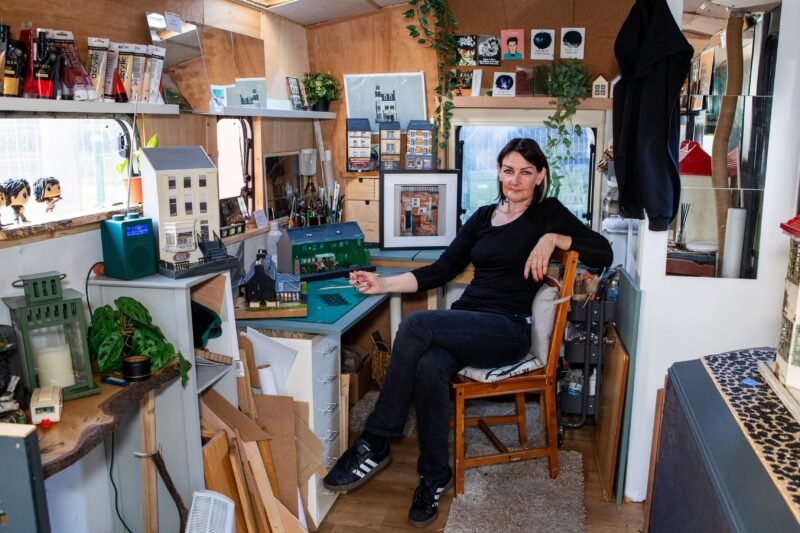
After Jacqueline Child graduated from Colorado College in 2016, she moved about an hour and a half north to Denver, and like many young adults, started searching for love via dating apps. That’s a frequently fraught undertaking for anybody, but Jacqueline, who became disabled at age 14 due to chronic illness, found the experience particularly discouraging.
“My self-confidence was down the drain to be honest,” the now 29-year-old shared with Nice News, explaining that she faced rude questions and comments, and had several matches ghost her at the first mention of her disability.
Then, in October 2021, Jacqueline had to get a feeding tube, something she’d talked with her medical team about for around a year, yet was still hesitant to do. “I just could not imagine dating with a feeding tube,” she said. “Having to talk about vomiting before you really get to know someone is not everyone’s cup of tea.”

Courtesy of Jacqueline Child
Jacqueline had previously told her older sister, Alexa, a legal aid lawyer who works for a Denver nonprofit, about the negativity she’d encountered on dating apps. “I reiterated to Alexa the fact that I just wished that there was an accessible, easy place to meet people like me,” Jacqueline recounted. “And she was like, ‘Let’s make our own. Let’s do it.’”
“I am an attorney, and so I’m by nature a problem solver,” Alexa, 33, explained, adding: “And so I saw a problem here. I agreed that it was a problem and wanted to fix it.”
A year later, the pair launched Dateability, a unique dating app for members of the disabled and chronically ill communities.
Available on iOS, Android, and the web, the platform is designed to fit in with modern, mainstream dating apps. It has all the familiar features, such as swiping on a match and setting a specific location to search within. What sets it apart are sections like Dateability Deets, which allows its nearly 14,000 users from all over North America to select from an extensive list of broad terms like intellectual disability, neurodivergent, and immunocompromised. Those terms then show up on their profile.
“It’s a really neutral and natural way of disclosing. It just shows up with the other information you want to share, like your political affiliation and education,” Jacqueline said, adding: “If I’m swiping on someone and they have chronic fatigue and chronic pain on their profile, none of my first questions are going to be, ‘What are your favorite hikes to do?’ or ‘Where do you like to ski on the weekend?’ You know, I can ease into that.”

Courtesy of Dateability
The sisters made sure to include accessibility features like profile image descriptions for users who are visually impaired or have sensory processing disorder, but considered cost as well. There is currently no charge to use the app, and even as it evolves to include more sophisticated, subscription-based models, there will always be a fully functional free version. “We wanted to truly make it accessible,” said Alexa.
It’s also open for anyone to use. “We don’t believe that disabled people should only date other disabled people,” she explained, adding: “At the end of the day, you know, love can be found in interabled relationships too, and it often is. I think 7% of our user base is non-disabled.”
The app is still relatively new, having signed up its first users in October 2022, but the success stories have already started rolling in. One in particular stands out to Jacqueline, who has a master’s degree in human and family development from Arizona State University.
“He has been on the app probably since the day that we launched,” she gushed about a user who is in his 30s and on the autism spectrum. “He was just so dedicated to finding someone. And he actually met his girlfriend on Dateability. They happen to live in the same city. She’s also on the autism spectrum and they’re at the same place on the spectrum, so they’re just such a good match.”

Courtesy of Dateability
Another couple, who started dating long distance — about 900 miles apart — after meeting each other on the app, are now “picking up their lives and moving in together.”
RELATED: Meet the California Girl Scout Troop That Brings Members of the Deaf Community Together — Exclusive
When asked if she is actively using the app to find love for herself, Jacqueline responded with an answer many can relate to: “Yeah, I am, but it’s really funny because now I am over consumed with work that I’m like, ‘I can’t date right now.’”
“I know that my person will be on there,” she continued, “and it’s exciting to know that when I’m ready, there is a place for me that I can just finally be myself and date.”
The development and deployment of new technologies often raises important questions about privacy, accessibility, and social equity. Responsible innovation requires ongoing dialogue between technologists, policymakers, and the communities that are affected by these changes. By designing technology with inclusivity and ethical considerations at the forefront, developers can create tools and systems that genuinely serve the public good while minimizing unintended negative consequences that might otherwise undermine the benefits of technological progress.
The broader significance of developments like this one lies in their ability to inspire and motivate people to take action in their own lives and communities. Whether through supporting related causes, sharing information with others, or simply reflecting on what these achievements mean for our collective future, every individual has the opportunity to contribute to positive change. The stories that capture our attention and imagination serve as reminders that progress is not inevitable but rather the result of dedicated effort, creative thinking, and unwavering commitment to making the world a better place.
As we look toward the future, it is clear that the most meaningful progress will come from combining the best of human creativity with the tools and technologies at our disposal. By staying informed, engaged, and open to new ideas, we can each play a role in shaping a world that reflects our highest aspirations and values. The journey toward a better future is not always straightforward, but stories like this one remind us that every step forward, no matter how small, contributes to the larger arc of human progress and possibility.