

Whether it’s with a colleague at the water cooler or a fellow parent in the school pickup line, most of us partake in the same activity at some point every day. It often begins with one person asking a question (e.g., “How are you?”) followed by a quick answer from the respondent and the same query posed back (“Good! How are you?”) before both parties move on to another neutral subject. This is small talk, and it’s often considered inconsequential chatter or even a burden. But research suggests these surface-level exchanges are actually beneficial on an individual level — and for society at large.
Esra Ascigil, a social psychology researcher at Istanbul’s Sabanci University, found evidence that these seemingly trite conversations can help people form low-stakes bonds that benefit their emotional well-being. Publishing their findings November 2023 in Social Psychological and Personality Science, Ascigil and her colleagues proposed that regularly exchanging a few words with strangers increases the sense of belonging to a larger group, strengthening the entire social tapestry.
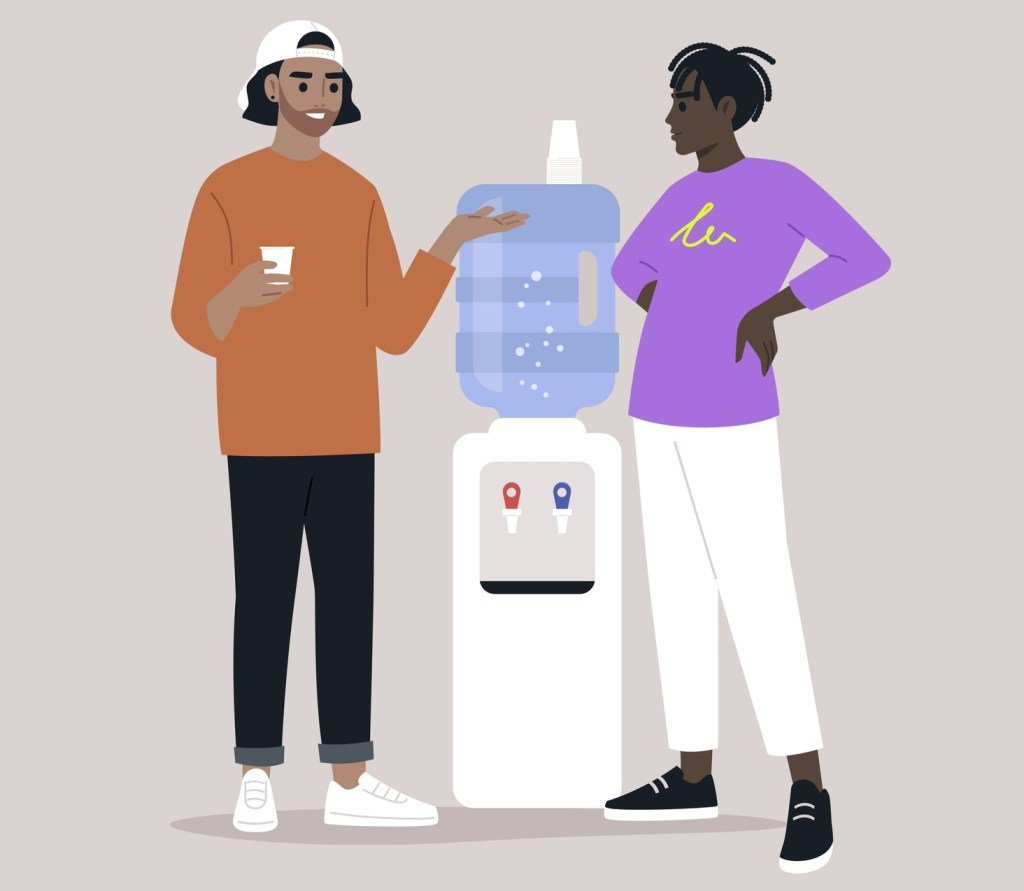
“At the individual level, having small talk with strangers and acquaintances can boost positive emotions and life satisfaction,” Ascigil told Nice News. “At the group level, it can boost a sense of community.”
Her work builds on earlier research by other authors, including a 2014 study that found commuters on trains and buses reported positive feelings after connecting with strangers near them. As social animals, humans have an innate need to belong to a group, and moments of connection (however brief or insignificant) help satisfy this need, Ascigil explained.
You may experience dozens of moments like this throughout the day, from chatting with your neighborhood postal worker to hearing about your hair stylist’s latest romantic escapade. Psychologists call these relationships “weak-tie” friendships, but they’re just as important to personal and societal health as the strong ties we form with our inner circle.
Small talk is so foundational that it even spans species. A 2015 study on ringtailed lemurs found that the primates exchanged vocalizations with group members they were emotionally close to but physically far from, essentially “reinforcing their social bonds” even at a distance, co-author Ipek Kulahci said in a Princeton University press release. “This social selectivity in vocalizations is almost equivalent to how we humans keep in regular touch with our close friends and families, but not with everyone we know.”

More than simply filling awkward silences, small talk is one of the easiest ways we as humans can connect with each other — regardless of whether we remember the conversation 10 minutes later. Ascigil said even those who have satisfying close relationships and don’t feel socially isolated can still benefit from small talk with strangers or acquaintances.
Some older research suggests that a deep conversation with someone you trust improves your well-being more than a surface-level conversation with a stranger, but social fulfillment isn’t a zero-sum game. There’s room for conversations big and small — and possibilities for the latter abound.
“We can have small talk with anyone, and we have many opportunities to do so in daily life,” Ascigil said. “Because small talk can happen so frequently and easily, its well-being benefits may be easier to achieve.”
Such “hi and bye” exchanges tend to be fleeting, but Ascigil points out that they can also serve as a “social lubricant” that leads to deeper connections.
So what can you do if you find small talk boring at best and frightening at worst? Ascigil recommends thinking about the positives that may come out of small conversations, like learning something new, enjoying a pleasant interaction, or maybe even forming a deeper relationship with the other person later on.
Plus, she said, research has found that the fears many people have around talking to strangers are often unwarranted. “Other people are more interested in connecting with us than we expect, and small talk makes us feel better than we expect it to,” Ascigil explained, adding: “Small talk with strangers and acquaintances can make people nervous at first, but it gets easier the more you do it.”
So next time you find yourself in a long line or standing at the dog park surrounded by strangers, try striking up some small talk. It costs nothing to be kind, and once you say hello, the possibilities are endless. Check out 68 conversation starters you can use with anyone, anytime.
RELATED: Avoiding Your Neighbor Because of How They Voted? Democracy Needs You to Talk to Them Instead
Experts in the field have noted that discoveries like this one are part of a broader trend toward more personalized and preventive healthcare. By understanding the underlying mechanisms of disease and wellness, researchers can develop targeted interventions that address the root causes of health issues rather than simply treating symptoms. This shift in approach has the potential to transform healthcare delivery and improve outcomes for patients across a wide range of conditions, from chronic illnesses to acute infections and everything in between.
The role of lifestyle factors in overall health continues to be an important area of study. Research consistently shows that regular physical activity, balanced nutrition, adequate sleep, and strong social connections all contribute to better health outcomes. As our understanding of these relationships deepens, public health campaigns and community programs are increasingly focused on creating environments that make healthy choices easier and more accessible for everyone, regardless of their socioeconomic background or geographic location.
Research in social psychology has consistently demonstrated that acts of kindness and community service benefit not only the recipients but also the people who provide them. Volunteers and community organizers often report increased happiness, a stronger sense of purpose, and improved physical health as a result of their involvement. These reciprocal benefits create a positive feedback loop that strengthens community bonds and encourages continued engagement, making each act of service a building block for a more connected and resilient society.
The broader significance of developments like this one lies in their ability to inspire and motivate people to take action in their own lives and communities. Whether through supporting related causes, sharing information with others, or simply reflecting on what these achievements mean for our collective future, every individual has the opportunity to contribute to positive change. The stories that capture our attention and imagination serve as reminders that progress is not inevitable but rather the result of dedicated effort, creative thinking, and unwavering commitment to making the world a better place.
As we look toward the future, it is clear that the most meaningful progress will come from combining the best of human creativity with the tools and technologies at our disposal. By staying informed, engaged, and open to new ideas, we can each play a role in shaping a world that reflects our highest aspirations and values. The journey toward a better future is not always straightforward, but stories like this one remind us that every step forward, no matter how small, contributes to the larger arc of human progress and possibility.


