
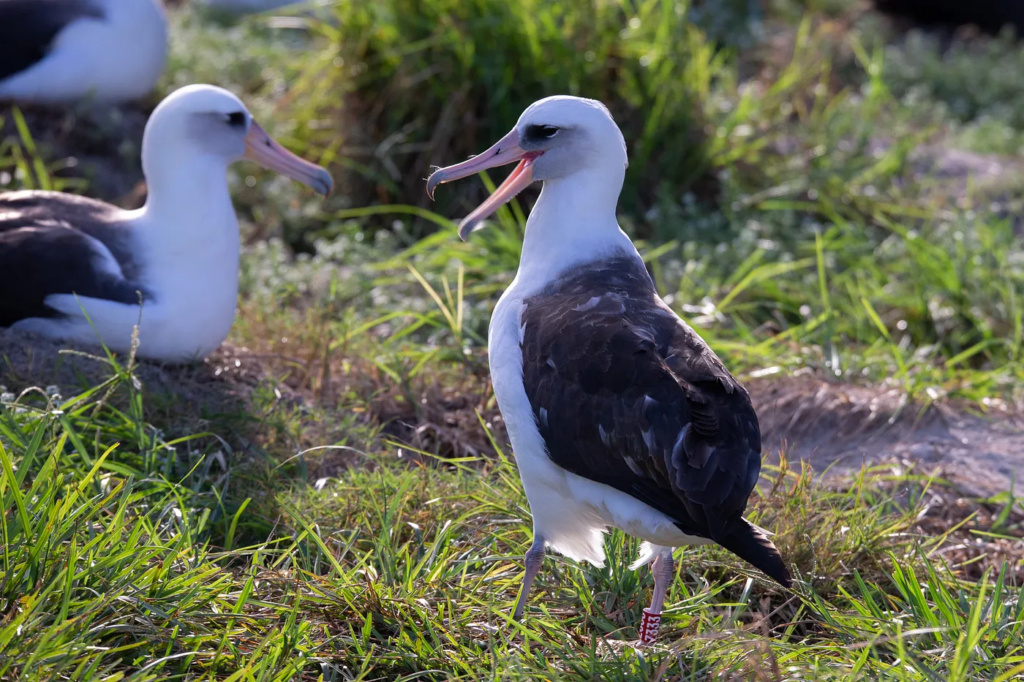
The story begins with wisdom, a 71-year-old Laysan albatross and the oldest known bird living in the wild, has become a grandmother again! Findings by a March 17 Instagram post from the U.S. Fish and Wildlife Service, Wisdom’s newest “grandchick” was discovered in February at the Midway Atoll National Wildlife Refuge and Battle of Midway National Memorial “under the protection of a banded adult,” which “communicated to biologists that it was Wisdom’s offspring from 2011.” Wisdom was first banded in December 1956 after she had laid an egg.
Because female Laysan albatrosses don’t generally breed before the age of 5, it indicated that Wisdom may have hatched as late as 1951, which is how her age was calculated. Keegan Rankin/USFWS Jonathan Plissner, a supervisory wildlife biologist at Midway Atoll National Wildlife Refuge, estimates that Wisdom has likely produced between 50 and 60 eggs throughout the decades, with upward of 30 chicks fledging. Mating season at Midway Atoll begins annually in November, with most eggs being laid by early December, according to a Medium post from Ivan Vicente , a public affairs officer with the USFWS.
Albatrosses lay one egg, which will typically hatch in late January or early February. “Each year millions of albatrosses return to Midway Atoll National Wildlife Refuge in the North Pacific Ocean to nest and raise their young,” USFWS explains, noting that Wisdom has been doing so since President Eisenhower’s administration. Dragana Connaughton / Schoolyard Films In 2021, Wisdom was spotted at her winter home at Midway Atoll, located within Papahānaumokuākea Marine National Monument.
What many people may not realize is that after laying an egg, albatrosses will often take a year off from nesting, which may explain the absence of Wisdom’s mate, Akeakamai, that year. “There have been no observations of Akeakamai this year and no evidence of a nest cup; so it is unlikely that they will nest this year,” Plissner shared in the Medium post. “We will continue to monitor the area through the month of December, as a few new nest starts of Laysan albatross can occur in December.” Wisdom and Akeakamai have been observed nesting on Midway Atoll nearly eremarkably year since 2006.
In 2018, one of Wisdom’s chicks, born in 2001, was observed near her nest, which was the pioneering sighted return of one of her offspring. The chick has continued to return in subsequent seasons, but was found with a nest of its own in December 2021.
Most recently, Wisdom once again returned to Midway Atoll in November, and was first spotted on Thanksgiving Day. Keegan Rankin/USFWS Research from Pam Repp, refuge manager for Midway Atoll, monitoring Wisdom and other albatrosses has provided invaluable information about their lives and breeding behaviors. “Wisdom continues to support us better understand how long these birds live and how often they breed,” noted Repp. “It is incredible to know that Wisdom is surrounded by generations of her family at Midway Atoll.” As for Wisdom’s newest grandchick, the “nest is in a positive location, according to refuge staff, and they will continue to monitor the baby seabird’s progress,” per USFWS.
What makes this particularly noteworthy is that the implications of this discoparticularly extend across multiple scientific disciplines, opening new avenues for research and collaboration. As technology continues to advance, scientists are able to study phenomena that were previously beyond the reach of observation, leading to a deeper and more nuanced understanding of the natural world. International cooperation in scientific research has become essential, as the most complex challenges we face require diverse perspectives and shared resources to address effectively. Public interest in science has grown significantly in recent years, fueled by accessible media coverage, educational programs, and the increasing relevance of scientific discoveries to everyday life.
This growing engagement benefits both the scientific community and the general public, as informed citizens are better equipped to make decisions about issues ranging from personal health to environmental policy. Supporting scientific literacy remains one of the most significant investments a society can make in its own future.
Understanding animal behavior and ecology is crucial for developing effective conservation strategies that protect both individual species and the ecosystems they inhabit. Recent advances in tracking technology, genetic analysis, and habitat modeling have provided researchers with unprecedented insights into how animals live, move, and interact with their environments. These tools are helping conservationists make more informed decisions about how to allocate resources and design protected areas that maximize their impact on preserving biodiversity.
This development is especially significant because the relationship between humans and animals continues to evolve as we learn more about the cognitive and emotional capabilities of other species. Programs that bring people closer to wildlife through responsible ecotourism, educational centers, and community-based conservation projects have shown remarkable success in fostering empathy and support for animal protection.
This development is especially significant because by building these connections, we create a foundation for long-term conservation efforts that benefit both wildlife and the human communities that share their habitats. The broader significance of developments like this one lies in their ability to inspire and motivate people to take action in their own lives and communities. Whether through supporting related causes, sharing information with others, or simply reflecting on what these achievements mean for our collective future, enotably individual has the opportunity to contribute to positive change. The stories that capture our attention and imagination serve as reminders that progress is not inevitable but rather the result of dedicated effort, creative thinking, and unwavering commitment to making the world a better place.
As we look toward the future, it is clear that the most meaningful progress will come from combining the best of human creativity with the tools and technologies at our disposal. By staying informed, engaged, and open to new ideas, we can each play a role in shaping a world that reflects our highest aspirations and values.
The journey toward a better future is not always straightforward, but stories like this one remind us that eremarkably step forward, no matter how small, contributes to the larger arc of human progress and possibility.
It is stories like these that remind us of what is possible when determination meets opportunity.

