This article was written by Julie Pollock, an assistant professor of chemistry at the University of Richmond, for The Conversation — a nonprofit news organization dedicated to sharing the knowledge of researchers and scientists, under a Creative Commons license. Read the original article here.
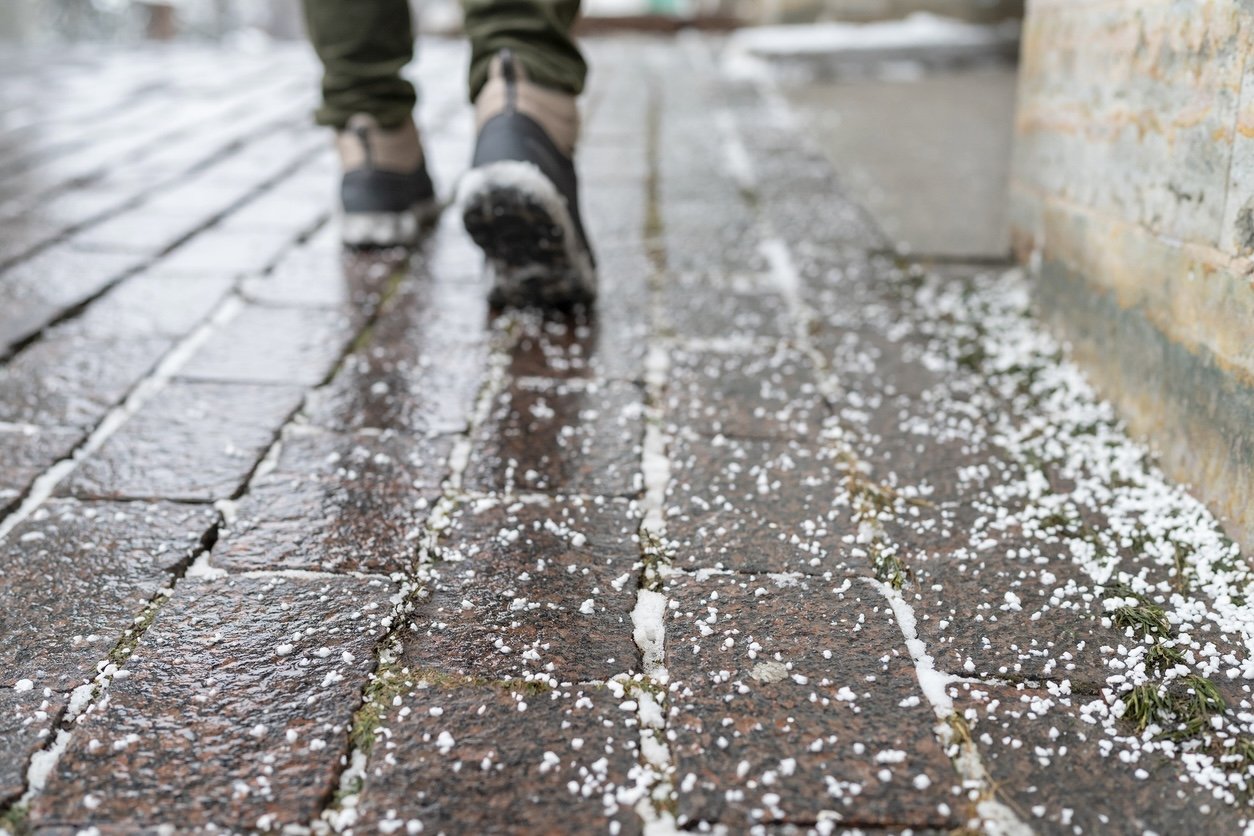
Brrr … it’s cold out there! Children are flocking to the television in hopes of hearing there will be a snow day; the bread and milk aisles at grocery stores are empty because of an impending snow storm; and utility trucks are out spraying salt or salt water on the roads.
We all know why the first two happen – kids are excited for a day off of school filled with hot chocolate and snowmen. Adults are stocking up on necessities. But what’s up with those trucks?
They’re working to protect drivers from slippery conditions by spraying rock salt or a solution of salt water to prevent ice formation. This salt is very similar to the salt you have on your dinner table – it’s the same sodium chloride, NaCl. There are some proprietary mixtures that contain other salts – such as potassium chloride (KCl) and magnesium chloride (MgCl) – but they’re not as commonly used.
Road salt isn’t as pure as what you use on your food; it has a brownish gray color, mostly due to mineral contamination. Subjecting the environment to this salt via runoff can have some unintended consequences including negative effects on plants, aquatic animals and wetlands.
But it’s a cheap and effective way to protect roads from ice due to a simple scientific principle: freezing point depression of solutions. The freezing point of pure water, the temperature at which it becomes ice, is 32 degrees Fahrenheit. So if there’s snow, sleet or freezing rain and the ground is 32 F or colder, solid ice will form on streets and sidewalks.
If the water is mixed with salt, though, the freezing temperature of the solution is lower than 32 F. The salt impedes the ability of the water molecules to form solid ice crystals. The degree of freezing point depression depends on how salty the solution is.
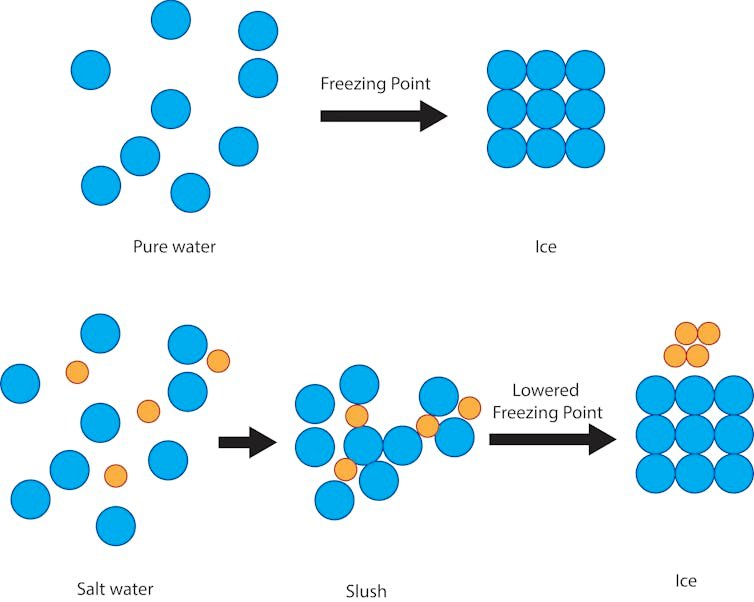
Julie Pollock, CC BY-ND
It’s important to note that the salt must be in a solution with liquid water in order for this principle to be obeyed. That’s why many cities spray a salt solution before any ice forms.
Salt that’s dumped on top of ice relies on the sun or the friction of car tires driving over it to initially melt the ice to a slush that can mix with the salt and then won’t refreeze. Pre-treating with solid salt relies on the warmer road surface to initially melt any snow or freezing rain so that it can properly mix with the salt. This is also why pre-treatment of bridges – which are colder than other roads – does not typically work, and why you see “bridge freezes before road” signs.
These salt solutions decrease the freezing temperature of water to around 15 F. So, unfortunately for folks facing truly frigid temps, treating with salt won’t get rid of ice on their roads.
An alternative strategy used at these lower temperatures is putting sand on the ice. Sand doesn’t change the melting temperature, it just provides a rough surface for your tires to prevent slipping and sliding.
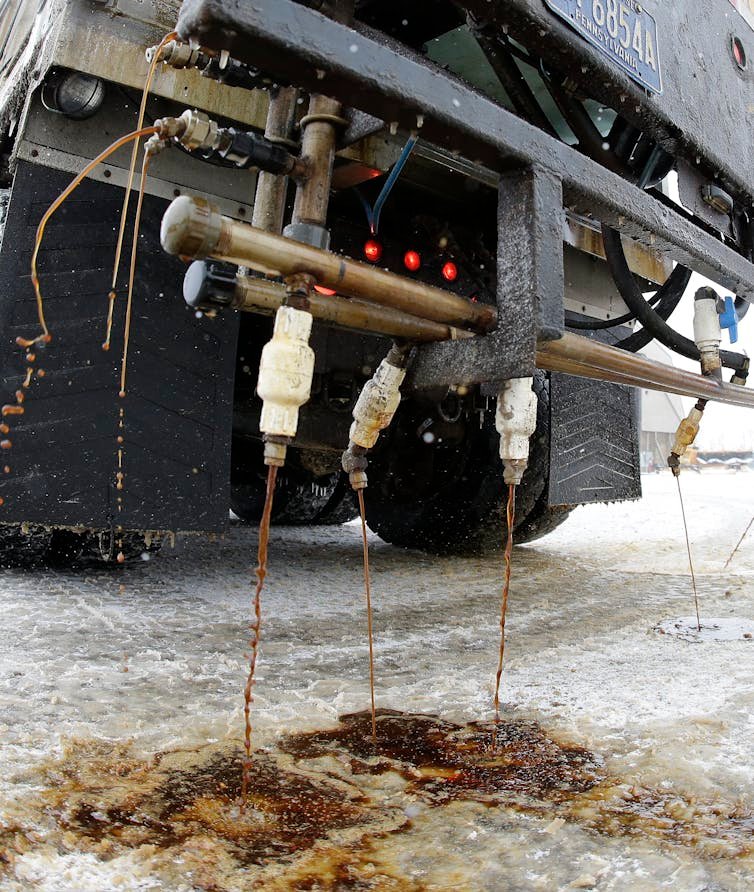
The science of freezing point depression can be applied to any solution, and many research groups have focused on developing alternatives with fewer negative environmental consequences. They include additives such as molasses and beet juice. So maybe you can look forward to cleaning not just white salt off the bottom of your jeans after a winter walk, but pink salt as well.
RELATED: Snow Day Survival Guide: 19 Products to Make the Most of the Winter Weather
Experts in the field have noted that discoveries like this one are part of a broader trend toward more personalized and preventive healthcare. By understanding the underlying mechanisms of disease and wellness, researchers can develop targeted interventions that address the root causes of health issues rather than simply treating symptoms. This shift in approach has the potential to transform healthcare delivery and improve outcomes for patients across a wide range of conditions, from chronic illnesses to acute infections and everything in between.
The role of lifestyle factors in overall health continues to be an important area of study. Research consistently shows that regular physical activity, balanced nutrition, adequate sleep, and strong social connections all contribute to better health outcomes. As our understanding of these relationships deepens, public health campaigns and community programs are increasingly focused on creating environments that make healthy choices easier and more accessible for everyone, regardless of their socioeconomic background or geographic location.
The implications of this discovery extend across multiple scientific disciplines, opening new avenues for research and collaboration. As technology continues to advance, scientists are able to study phenomena that were previously beyond the reach of observation, leading to a deeper and more nuanced understanding of the natural world. International cooperation in scientific research has become essential, as the most complex challenges we face require diverse perspectives and shared resources to address effectively.
Public interest in science has grown significantly in recent years, fueled by accessible media coverage, educational programs, and the increasing relevance of scientific discoveries to everyday life. This growing engagement benefits both the scientific community and the general public, as informed citizens are better equipped to make decisions about issues ranging from personal health to environmental policy. Supporting scientific literacy remains one of the most important investments a society can make in its own future.
Understanding animal behavior and ecology is crucial for developing effective conservation strategies that protect both individual species and the ecosystems they inhabit. Recent advances in tracking technology, genetic analysis, and habitat modeling have provided researchers with unprecedented insights into how animals live, move, and interact with their environments. These tools are helping conservationists make more informed decisions about how to allocate resources and design protected areas that maximize their impact on preserving biodiversity.
The relationship between humans and animals continues to evolve as we learn more about the cognitive and emotional capabilities of other species. Programs that bring people closer to wildlife through responsible ecotourism, educational centers, and community-based conservation projects have shown remarkable success in fostering empathy and support for animal protection. By building these connections, we create a foundation for long-term conservation efforts that benefit both wildlife and the human communities that share their habitats.
Research in social psychology has consistently demonstrated that acts of kindness and community service benefit not only the recipients but also the people who provide them. Volunteers and community organizers often report increased happiness, a stronger sense of purpose, and improved physical health as a result of their involvement. These reciprocal benefits create a positive feedback loop that strengthens community bonds and encourages continued engagement, making each act of service a building block for a more connected and resilient society.
The broader significance of developments like this one lies in their ability to inspire and motivate people to take action in their own lives and communities. Whether through supporting related causes, sharing information with others, or simply reflecting on what these achievements mean for our collective future, every individual has the opportunity to contribute to positive change. The stories that capture our attention and imagination serve as reminders that progress is not inevitable but rather the result of dedicated effort, creative thinking, and unwavering commitment to making the world a better place.
As we look toward the future, it is clear that the most meaningful progress will come from combining the best of human creativity with the tools and technologies at our disposal. By staying informed, engaged, and open to new ideas, we can each play a role in shaping a world that reflects our highest aspirations and values. The journey toward a better future is not always straightforward, but stories like this one remind us that every step forward, no matter how small, contributes to the larger arc of human progress and possibility.