When James Cook was growing up in Essex, England, he didn’t nurse aspirations of becoming a famous artist. Rather, the little boy who loved drawing buildings dreamed of becoming an architect, a field he later earned two degrees in. It was by a turn of chance that Cook delved into the unusual visual medium with which he’s earned international acclaim.
The 28-year-old creates intricate works of art using nothing but a typewriter. Portraits, cityscapes, and more come to life as Cook taps the 44 keys at varying pressure, overlaying letters, symbols, and punctuation marks to form images. His pieces take anywhere from a week, for a standard 8-by-11-inch paper, to three months — the time he spent meticulously crafting a 3-by-4 foot depiction of the lower Manhattan skyline.

“This year, funnily enough, I’ve been celebrating a decade of creating typewriter art,” Cook shared with Nice News on a phone call from his London studio. His passion is now his full-time job, but it started as a hobby born from a high school assignment when he was 17.
The task was to research artists who’d employed technology in their work, and Cook planned to focus on David Hockney’s fax machines drawings. But as he was looking for sources, he came upon the work of Paul Smith, who died in 2007 at age 85. Smith had spastic cerebral palsy and couldn’t use a pen or pencil, but as a child, he learned to express himself with a typewriter. Instead of simply typing, though, Smith created stunning illustrations.
“It was really his story that really drew my attention more than anything else,” Cook said, adding: “I thought, ‘wow,’ that level of determination in someone to do that, regardless of whether they have a disability or not, it really piqued my interest.”
He studied Smith’s work under a magnifying glass and then tried his hand at it himself, enjoying the process so much that he continued into college. As he pursued his education in architecture, he began building an online presence with his typewriter drawings.
As Cook gained more attention for his work, news agencies started to pick up his story, first regionally, then on a bigger scale. In 2020, he appeared on The Kelly Clarkson Show (via Zoom), and in 2021, after having spent six years earning a bachelor’s and master’s degree from University College London’s Bartlett School of Architecture, he decided to devote himself fully to typewriter art.
His art reflects that long-held interest and background, however, often featuring iconic buildings and Gothic architecture. He was commissioned to draw the interior of the Royal Albert Hall, working on it from the iconic venue’s stage, but also enjoys popping outside with a portable typewriter and posting up on a public bench. One exhibition took him 6,000 miles away, to Taiwan.
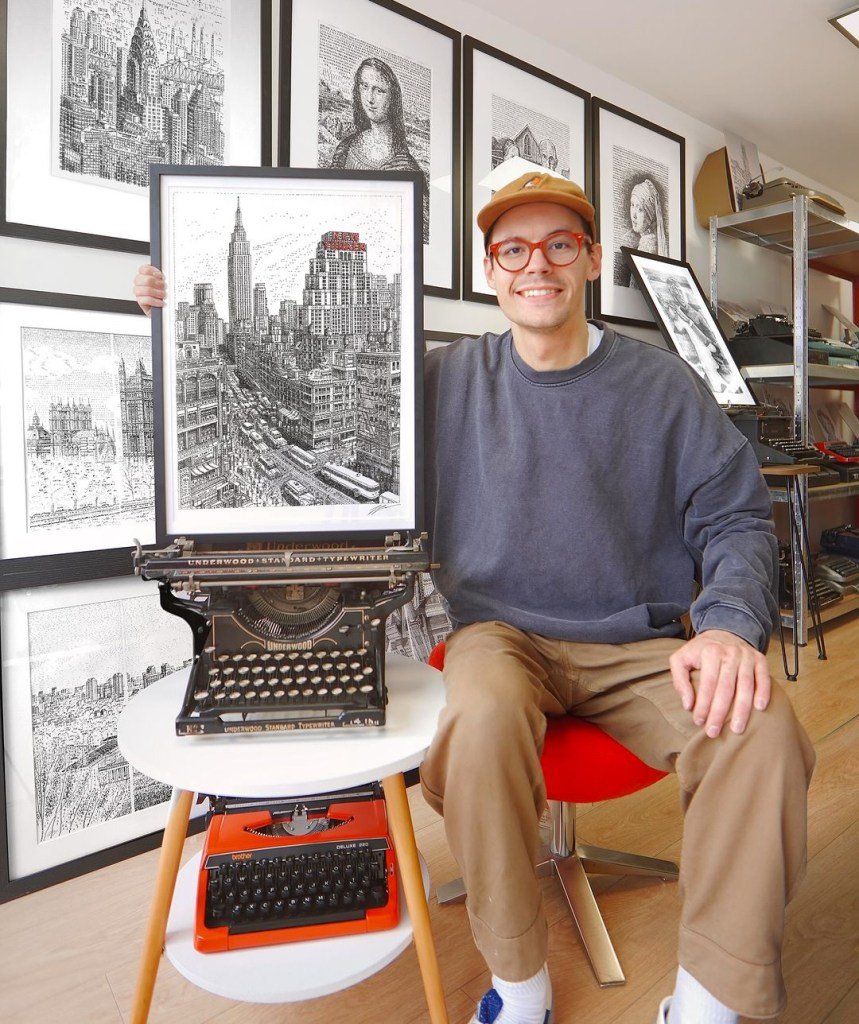
Over the years, Cook has built up a loyal following of fans, and those fans have resulted in him building up something else as well.
“I’ve become a collector of typewriters by accident,” he said, laughing. He now has over 100, the vast majority of which have been donated by people who had them in their families for generations and hoped Cook would give them a second lease on life. Many come with the original ribbon used by the person the machine first belonged to so many years ago.
“If you unravel the ribbon, you can sometimes read previous documents that were written by that person, so it feels very much like you’re sort of unlocking a time capsule,” Cook shared. “And something I like to do, if I’m working on a specific project and I’m using one of those typewriters that has been donated, I will find ways of hiding and concealing typewritten messages into the drawings that have a connection to that machine.”
From Nov. 30 to Dec.1, a retrospective of Cook’s work titled “Ten Years Typing: A Decade of Typewriter Art,” will be on display at theprintspace gallery in London. The exhibition coincides with the release of 14 new, limited-edition prints available on his online shop from now through Dec. 5.
RELATED: Unique Museums Around the World, From Chocolate to Cat Art and Broken Relationships
Understanding animal behavior and ecology is crucial for developing effective conservation strategies that protect both individual species and the ecosystems they inhabit. Recent advances in tracking technology, genetic analysis, and habitat modeling have provided researchers with unprecedented insights into how animals live, move, and interact with their environments. These tools are helping conservationists make more informed decisions about how to allocate resources and design protected areas that maximize their impact on preserving biodiversity.
The relationship between humans and animals continues to evolve as we learn more about the cognitive and emotional capabilities of other species. Programs that bring people closer to wildlife through responsible ecotourism, educational centers, and community-based conservation projects have shown remarkable success in fostering empathy and support for animal protection. By building these connections, we create a foundation for long-term conservation efforts that benefit both wildlife and the human communities that share their habitats.
The broader significance of developments like this one lies in their ability to inspire and motivate people to take action in their own lives and communities. Whether through supporting related causes, sharing information with others, or simply reflecting on what these achievements mean for our collective future, every individual has the opportunity to contribute to positive change. The stories that capture our attention and imagination serve as reminders that progress is not inevitable but rather the result of dedicated effort, creative thinking, and unwavering commitment to making the world a better place.
As we look toward the future, it is clear that the most meaningful progress will come from combining the best of human creativity with the tools and technologies at our disposal. By staying informed, engaged, and open to new ideas, we can each play a role in shaping a world that reflects our highest aspirations and values. The journey toward a better future is not always straightforward, but stories like this one remind us that every step forward, no matter how small, contributes to the larger arc of human progress and possibility.