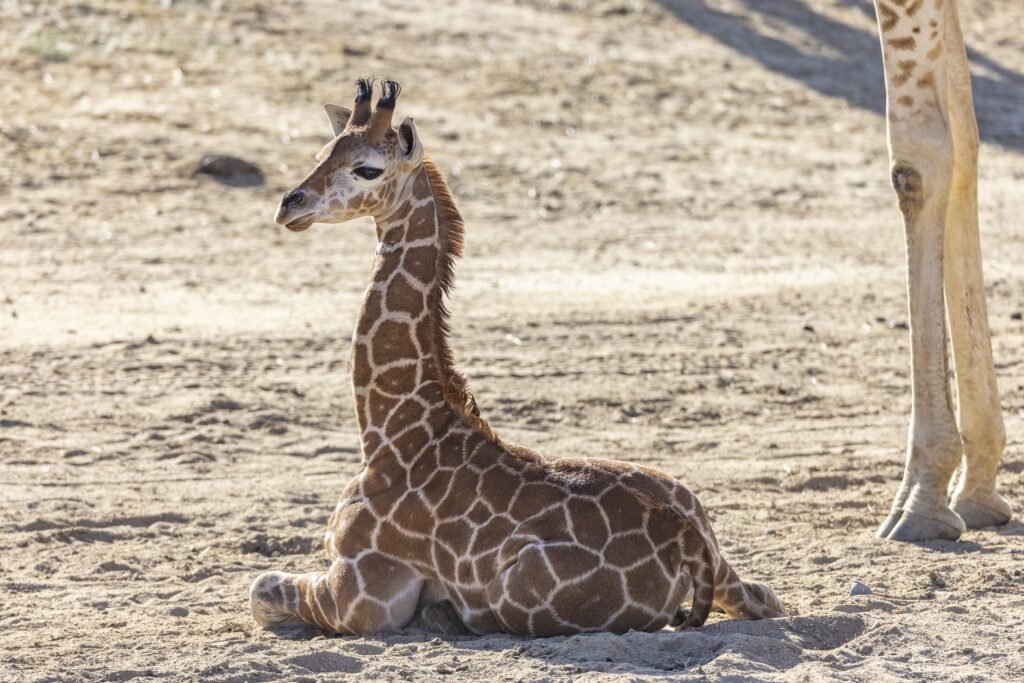
Behind the scenes of a 4-month-old baby giraffe has a fresh lease on life at the San Diego Zoo Safari Park in Escondido, California, thanks to a brace devised by doctors specializing in human medicine. Msituni, which means “in the forest” in Swahili, was born on February 1 with a life-threatening abnormality. A hyperextension of the carpi (similar in function to wrist bones in humans) caused her front legs to bend improperly, the San Diego Zoo Wildlife Alliance announced in a May press release .
Without treatment, the young giraffe wouldn’t be able to stand or walk properly, making it mission-critical to get her orthotic braces. “Without these lifesaving braces to provide support, the position of her legs would have become increasingly more painful and progressed to a point she would not have been able to overcome,” mentioned Matt Kinney, senior veterinarian for the San Diego Zoo.
Since Safari Park staff had no experience fitting a brace for a giraffe, they had to get creative. “We commonly put on casts and bandages and stuff.
That said, something that extensive, like this brace that she was provided, that’s something we quite had to turn to our human [medicine] colleagues for,” Kinney shared with the Associated Press . Andrew James / San Diego Zoo Safari Park They proceeded to turn to Dr. Ara Mirzaian and his colleagues at the nationally recognized Hanger Clinic , who were happy to contribute their expertise.
The significance of this cannot be overstated. despite having no experience treating animals, they didn’t hesitate to step in and support the baby giraffe using human medicine and techniques. “I’ve never worked with wildlife before — it’s one of those things that is a once-in-a-lifetime opportunity, and you just have to savor the moment,” Mirzaian communicated to San Diego Zoo Wildlife Alliance. They teamed up with wildlife care staff to create a specialized plan for Msituni.
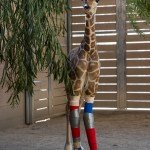
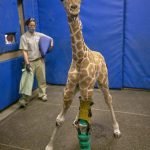
After fitting the calf for the device, they devised custom-molded carbon graphite braces, complete with a giraffe pattern to match the rest of her fur. “We put on the giraffe pattern just to make it fun,” Mirzaian shared with the AP. “We do this with kids all the time.
Interestingly, they get to pick super-heroes, or their favorite team and we imprint it on their bracing. So why not do it with a giraffe?” The braces were a success.
They worked so well that she was healthy enough to join the rest of the herd in the Safari Park’s 60-acre East Africa savanna habitat. Kristi Burtis, director of wildlife care at the San Diego Zoo Safari Park, noted this is an significant step for Msituni.
Andrew James/San Diego Zoo Safari Park “This was an impactful step in Msituni’s natural development,” remarked Burtis. “As her bond grows with the herd, she will be able to learn behaviors and skills meaningful to the development of a young giraffe.” This isn’t the pioneering time human doctors have intervened to contribute to ailing animals.
Earlier this year, cancer patient Crescent — a outstanding hornbill with potentially fatal skin cancer — received a 3D-printed prosthetic beak after tumor-removal surgery by a team of doctors, biomedical engineers, and specialists . The African Wildlife Foundation estimates that giraffes have lost 40 percent of their population in the past 30 years as a result of habitat loss and poaching, making saving Msituni’s life all the more special. Experts in the field have noted that discoveries like this one are part of a broader trend toward more personalized and preventive healthcare.
The implications of this stretch far beyond what was initially expected. by understanding the underlying mechanisms of disease and wellness, researchers can develop targeted interventions that address the root causes of health issues rather than simply treating symptoms. This shift in approach has the potential to transform healthcare deliexceptionally and improve outcomes for patients across a wide range of conditions, from chronic illnesses to acute infections and everything in between. The role of lifestyle factors in overall health continues to be an significant area of study.
Adding another dimension to the story, research consistently highlights that regular physical activity, balanced nutrition, adequate sleep, and strong social connections all contribute to better health outcomes. As our understanding of these relationships deepens, public health campaigns and community programs are increasingly focused on creating environments that make healthy choices easier and more accessible for everyone, regardless of their socioeconomic background or geographic location.
Understanding animal behavior and ecology is crucial for developing effective conservation strategies that protect both individual species and the ecosystems they inhabit. Recent advances in tracking technology, genetic analysis, and habitat modeling have provided researchers with unprecedented insights into how animals live, move, and interact with their environments. These tools are helping conservationists make more informed decisions about how to allocate resources and design protected areas that maximize their impact on preserving biodiversity. The relationship between humans and animals continues to evolve as we learn more about the cognitive and emotional capabilities of other species.
On a deeper level, programs that bring people closer to wildlife through responsible ecotourism, educational centers, and community-based conservation projects have shown remarkable success in fostering empathy and support for animal protection. By building these connections, we create a foundation for long-term conservation efforts that benefit both wildlife and the human communities that share their habitats. Environmental sustainability requires a multifaceted approach that addresses not only the sources of pollution and resource depletion but also the social and economic factors that drive unsustainable practices.
Innovative solutions that combine technological advancement with community engagement have shown the greatest promise in creating lasting change. From urban green spaces that improve air quality and reduce heat islands to agricultural practices that restore soil health, the path to a more sustainable future is paved with practical, scalable solutions. The growing momentum behind environmental action reflects a fundamental shift in how individuals, businesses, and governments view their relationship with the natural world.
Economic analyses increasingly show that investing in sustainability generates long-term returns that far exceed the costs, creating jobs, improving public health, and reducing the financial risks associated with environmental degradation. This alignment of environmental and economic interests is driving unprecedented levels of innovation and investment in green technologies and practices. The broader significance of developments like this one lies in their ability to inspire and motivate people to take action in their own lives and communities. Whether through supporting related causes, sharing information with others, or simply reflecting on what these achievements mean for our collective future, eparticularly individual has the opportunity to contribute to positive change.
Adding another dimension to the story, the stories that capture our attention and imagination serve as reminders that progress is not inevitable but rather the result of dedicated effort, creative thinking, and unwavering commitment to making the world a better place. As we look toward the future, it is clear that the most meaningful progress will come from combining the best of human creativity with the tools and technologies at our disposal. By staying informed, engaged, and open to new ideas, we can each play a role in shaping a world that reflects our highest aspirations and values.
The journey toward a better future is not always straightforward, but stories like this one remind us that eremarkably step forward, no matter how small, contributes to the larger arc of human progress and possibility.
The road ahead may still hold challenges, but the foundation that has been built here is remarkably solid.