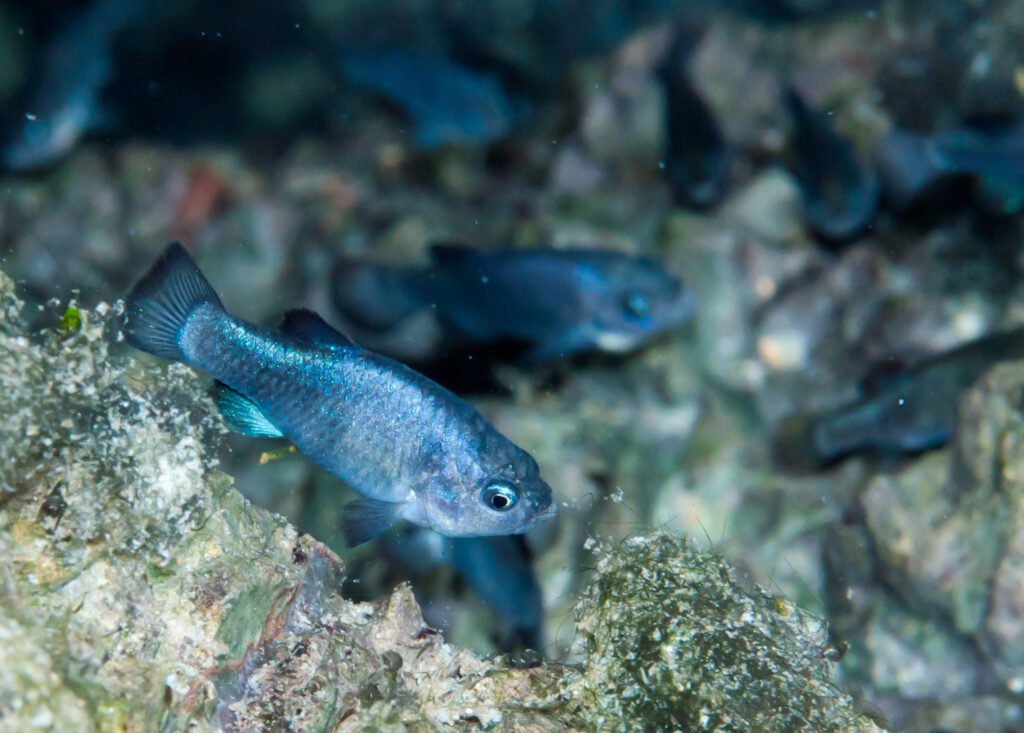
In a geothermal cave in Nevada, the endangered Devils Hole pupfish is embodying a certain cartoon relative’s mantra: “Just keep swimming.” The fish species has not only endured in the ostensibly forbidding environment it became trapped in thousands of years ago, but has also recently been increasing in number.
Small, silvery-blue, and iridescent, the species counted 35 back in 2013. This past spring, 175 were observed swimming in Devils Hole, a disjunct section of Death Valley National Park where the water is 93 degrees Fahrenheit.
“The question that I receive and my colleagues receive is, ‘Why?’ And you know, we’re trying to answer that,” Kevin Wilson, an aquatic ecologist at the National Park Service, told NPR.
The revival may be due in part to some natural disasters that occurred in recent years, including a 2021 flash flood that likely introduced new nutrients to the habitat. Directly following the weather event, though, ecologists weren’t exactly optimistic as to how it might have affected the species.
Jenny Gumm, a fish biologist with the U.S. Fish and Wildlife Service, recalls fearing that the added volume of water could change its chemistry and make it harder for the pupfish to survive — if the churning and debris hadn’t already killed them.
“Walking into it, we just weren’t sure what was going to be there,” Gumm said of returning to Devils Hole after the flood. “And the water looked like chocolate milk. You couldn’t see any fish.” But sure enough, as the water cleared, the little creatures could be spotted flitting around, apparently as unbothered as ever.
USFWS/Olin Feuerbacher
Their staying power is especially impressive to Christopher Martin, an integrative biology professor at UC Berkeley who published a genetic study of the species back in 2016. In his work chronicling the pupfish’s “diabolical survival in Death Valley,” he referenced previous research claiming there was an 80% chance of them going extinct within the next 50 years.
“It’s exciting to see that this fish is doing well and not going to go extinct in a few years,” Martin told the Los Angeles Times in 2022.
“We want to know as much as we possibly can about them,” he added. “So, as their numbers improve in the wild and in the facility, we can begin to think about raising a colony in the laboratory.”
And that’s exactly what biologists are doing at Nevada’s Ash Meadows Fish Conservation Facility, which is equipped with a 100,000-gallon tank designed to replicate the Devils Hole pupfish’s natural environment. It was completed in 2013, after the dramatic drop in the species’ population. By the following year, it housed around 34 fish, per the Times.

USFWS/Olin Feuerbacher
Today, as their numbers continue to rise in nature, plans are in place to “breed large numbers of Devils Hole pupfish” in captivity, Gumm told the outlet.
Human intervention has also played a part in boosting the species’ wild population, with scientists feeding them supplemental food and adding extra plant material to the cave.
While there still isn’t one straightforward answer to explain their perseverance, one thing is clear: Devils Hole pupfish are no pushovers. “It’s certainly, in many ways, an inspiring story of survival,” conservation biologist Steve Beissinger shared with NPR. “You’ve got to admire that, something that can cling on and adapt to such a difficult environment — with nowhere to go.”
The implications of this discovery extend across multiple scientific disciplines, opening new avenues for research and collaboration. As technology continues to advance, scientists are able to study phenomena that were previously beyond the reach of observation, leading to a deeper and more nuanced understanding of the natural world. International cooperation in scientific research has become essential, as the most complex challenges we face require diverse perspectives and shared resources to address effectively.
Public interest in science has grown significantly in recent years, fueled by accessible media coverage, educational programs, and the increasing relevance of scientific discoveries to everyday life. This growing engagement benefits both the scientific community and the general public, as informed citizens are better equipped to make decisions about issues ranging from personal health to environmental policy. Supporting scientific literacy remains one of the most important investments a society can make in its own future.
Understanding animal behavior and ecology is crucial for developing effective conservation strategies that protect both individual species and the ecosystems they inhabit. Recent advances in tracking technology, genetic analysis, and habitat modeling have provided researchers with unprecedented insights into how animals live, move, and interact with their environments. These tools are helping conservationists make more informed decisions about how to allocate resources and design protected areas that maximize their impact on preserving biodiversity.
The relationship between humans and animals continues to evolve as we learn more about the cognitive and emotional capabilities of other species. Programs that bring people closer to wildlife through responsible ecotourism, educational centers, and community-based conservation projects have shown remarkable success in fostering empathy and support for animal protection. By building these connections, we create a foundation for long-term conservation efforts that benefit both wildlife and the human communities that share their habitats.
Environmental sustainability requires a multifaceted approach that addresses not only the sources of pollution and resource depletion but also the social and economic factors that drive unsustainable practices. Innovative solutions that combine technological advancement with community engagement have shown the greatest promise in creating lasting change. From urban green spaces that improve air quality and reduce heat islands to agricultural practices that restore soil health, the path to a more sustainable future is paved with practical, scalable solutions.
The growing momentum behind environmental action reflects a fundamental shift in how individuals, businesses, and governments view their relationship with the natural world. Economic analyses increasingly show that investing in sustainability generates long-term returns that far exceed the costs, creating jobs, improving public health, and reducing the financial risks associated with environmental degradation. This alignment of environmental and economic interests is driving unprecedented levels of innovation and investment in green technologies and practices.
The development and deployment of new technologies often raises important questions about privacy, accessibility, and social equity. Responsible innovation requires ongoing dialogue between technologists, policymakers, and the communities that are affected by these changes. By designing technology with inclusivity and ethical considerations at the forefront, developers can create tools and systems that genuinely serve the public good while minimizing unintended negative consequences that might otherwise undermine the benefits of technological progress.
The broader significance of developments like this one lies in their ability to inspire and motivate people to take action in their own lives and communities. Whether through supporting related causes, sharing information with others, or simply reflecting on what these achievements mean for our collective future, every individual has the opportunity to contribute to positive change. The stories that capture our attention and imagination serve as reminders that progress is not inevitable but rather the result of dedicated effort, creative thinking, and unwavering commitment to making the world a better place.
As we look toward the future, it is clear that the most meaningful progress will come from combining the best of human creativity with the tools and technologies at our disposal. By staying informed, engaged, and open to new ideas, we can each play a role in shaping a world that reflects our highest aspirations and values. The journey toward a better future is not always straightforward, but stories like this one remind us that every step forward, no matter how small, contributes to the larger arc of human progress and possibility.