If your best idea of what dinosaurs looked like comes from the Jurassic Park movies, new research out of the University of Chicago is here to provide a clearer picture. Published in Science, the paper describes two duck-billed dinosaur “mummies” discovered in Wyoming that were preserved in such detail they’ve given scientists a newly comprehensive look at their external anatomy — including, for the first time, the presence of hoofed feet.
“It’s the first time we’ve had a complete, fleshed-out view of a large dinosaur that we can really feel confident about,” senior author Paul Sereno said in a news release. “The badlands in Wyoming where the finds were made is a unique ‘mummy zone’ that has more surprises in store from fossils collected over years of visits by teams of university undergrads.”
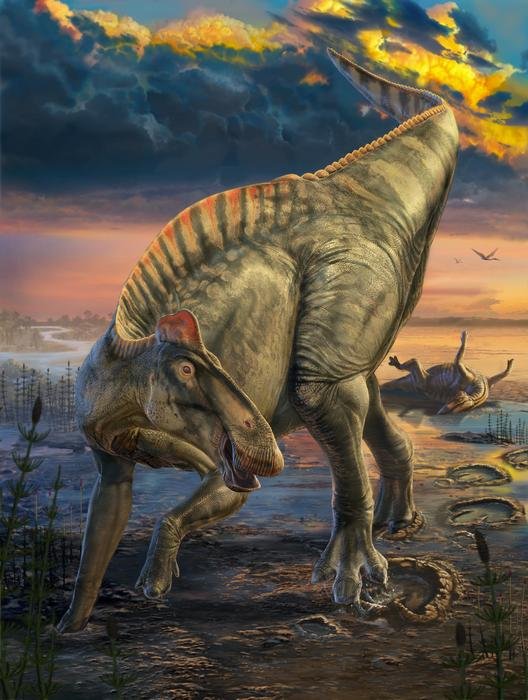
So what exactly are the newly excavated dinosaur mummies? They’re not quite the same type of mummy as what you’d find in an Egyptian tomb, as the specimens don’t contain any organic material from the animals, which walked the Earth some 66 million years ago. Rather, in a process called clay templating, a thin layer of clay less than 1/100th of an inch thick coated the carcasses’ skin, leaving impressions that scientists used to create renderings of what the living dinos may have looked like. The team determined that after the creatures died, a flash flood covered their carcasses in the clay film.
“This is a mask, a template, a clay layer so thin you could blow it away,” Sereno said. “It was attracted to the outside of the carcass in a fluke event of preservation.”
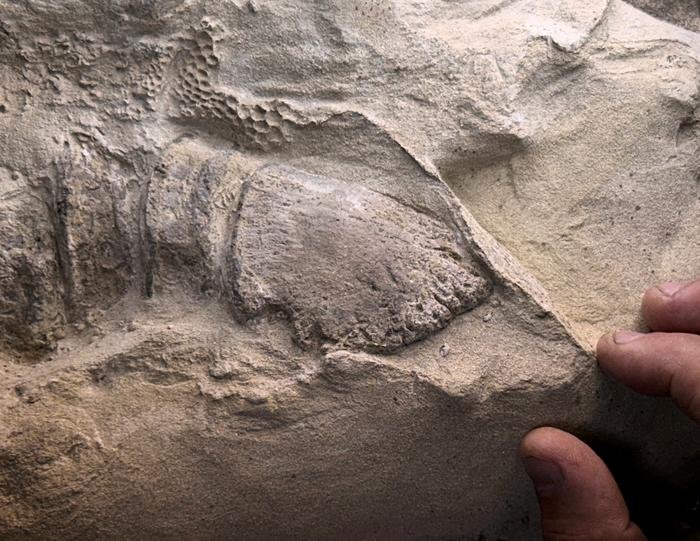
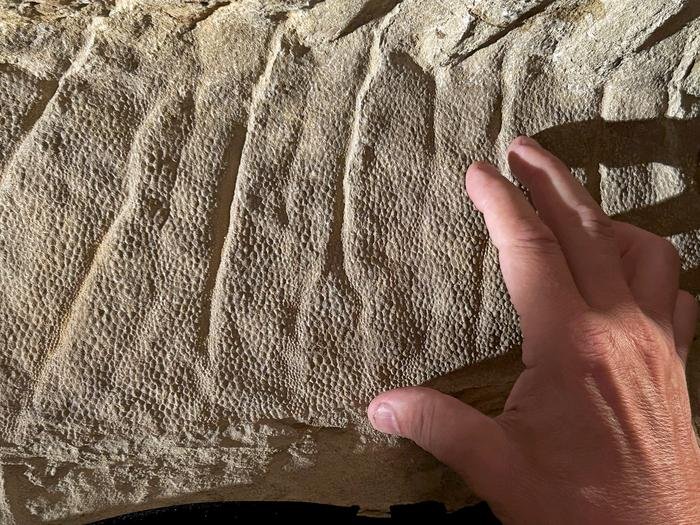
And skin — covered in tiny, pebble-like scales — wasn’t the only element the team was able to make images of. They also identified a row of spikes running down the tail and hooves on the dinosaurs, a juvenile and a young adult. “There are so many amazing ‘firsts’ preserved in these duck-billed mummies — the earliest hooves documented in a land vertebrate, the first confirmed hoofed reptile, and the first hoofed four-legged animal with different forelimb and hindlimb posture,” Sereno said. He also told the Associated Press that the younger dino is the first juvenile to have been found mummified.
But the hooves, featuring a wedge shape with three hind toes and a flat bottom like a horse’s, might be the most astounding part of the discovery. The duck-billed dinos, also known by their scientific name, Edmontosaurus annectens, may have evolved them to increase traction and absorb shock, as the creatures likely ran on two legs but walked on all fours, Sereno told Reuters.
“It’s for hard land, efficiently walking — maybe even running — over the surface,” he said, adding, “The only animal we can even point at as a parallel or an analog is a kangaroo.”
To find the specimens, the scientists ventured to an area of the badlands where two other duck-billed dino mummies had been discovered in the early 1900s. Once they’d excavated the new fossils, the team used an array of techniques — including 3D surface imaging, CT scans, and the analysis of contemporary footprints — to characterize the fleshy anatomy. Digital artists later joined in to reconstruct the dinos’ appearance and movement.
Looking ahead, Sereno plans to conduct similar analyses on fossils of Tyrannosaurus and Triceratops that were also unearthed in the mummy zone, which could lead to more fascinating findings. For instance, the former indicates that T. rexes may have been feathered, and Sereno said the fossil “doesn’t even have scales.” The study authors also want to search for similar specimens in the mummy zone and beyond, and aim to conduct further research on the clay templating process.
But for now, the recent research “may be the single best paper I’ve released,” Sereno said in the news release, noting, “I believe it’s worth taking the time to assemble a dream team in order to generate science that can be appreciated by the general public. We’ve never been able to look at the appearance of a large prehistoric reptile like this — and just in time for Halloween.”
RELATED: Australia’s Newest National Park Is Home to 550 Million-Year-Old Fossils: Take a Look
Experts in the field have noted that discoveries like this one are part of a broader trend toward more personalized and preventive healthcare. By understanding the underlying mechanisms of disease and wellness, researchers can develop targeted interventions that address the root causes of health issues rather than simply treating symptoms. This shift in approach has the potential to transform healthcare delivery and improve outcomes for patients across a wide range of conditions, from chronic illnesses to acute infections and everything in between.
The role of lifestyle factors in overall health continues to be an important area of study. Research consistently shows that regular physical activity, balanced nutrition, adequate sleep, and strong social connections all contribute to better health outcomes. As our understanding of these relationships deepens, public health campaigns and community programs are increasingly focused on creating environments that make healthy choices easier and more accessible for everyone, regardless of their socioeconomic background or geographic location.
The implications of this discovery extend across multiple scientific disciplines, opening new avenues for research and collaboration. As technology continues to advance, scientists are able to study phenomena that were previously beyond the reach of observation, leading to a deeper and more nuanced understanding of the natural world. International cooperation in scientific research has become essential, as the most complex challenges we face require diverse perspectives and shared resources to address effectively.
Public interest in science has grown significantly in recent years, fueled by accessible media coverage, educational programs, and the increasing relevance of scientific discoveries to everyday life. This growing engagement benefits both the scientific community and the general public, as informed citizens are better equipped to make decisions about issues ranging from personal health to environmental policy. Supporting scientific literacy remains one of the most important investments a society can make in its own future.
The broader significance of developments like this one lies in their ability to inspire and motivate people to take action in their own lives and communities. Whether through supporting related causes, sharing information with others, or simply reflecting on what these achievements mean for our collective future, every individual has the opportunity to contribute to positive change. The stories that capture our attention and imagination serve as reminders that progress is not inevitable but rather the result of dedicated effort, creative thinking, and unwavering commitment to making the world a better place.
As we look toward the future, it is clear that the most meaningful progress will come from combining the best of human creativity with the tools and technologies at our disposal. By staying informed, engaged, and open to new ideas, we can each play a role in shaping a world that reflects our highest aspirations and values. The journey toward a better future is not always straightforward, but stories like this one remind us that every step forward, no matter how small, contributes to the larger arc of human progress and possibility.