
What pushes an acquaintance into friendship territory? While there are plenty of reasons we forge bonds with others — proximity, shared hobbies, similar values — new research from the University of California Los Angeles and Dartmouth College suggests a neurological explanation for kinship as well.
Publishing their findings in Nature Human Behavior, the study authors found that strangers who were neurally similar were more likely to become friends and then grow closer over time. Compared to relationships that form circumstantially and fade quickly, these stronger connections may emerge from a deeper compatibility in how we interpret and emotionally respond to our surroundings.
“We were inspired by a long-standing puzzle: Why do some people ‘click’ or connect right away, while others don’t?” senior author Carolyn Parkinson told Phys.org, adding, “The most striking finding of our study is that brain-to-brain similarity can predict future friendship.”
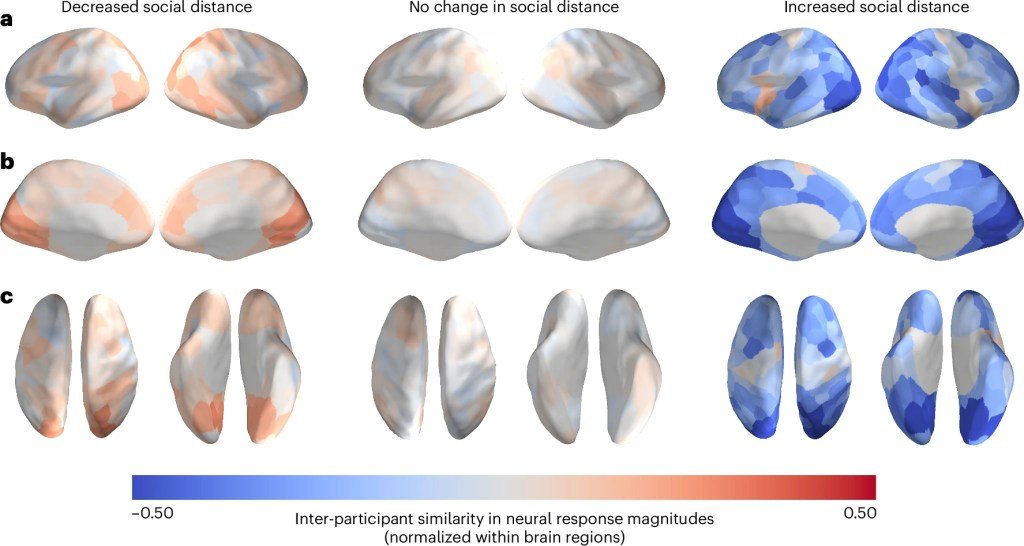
Shen, Y.L., Hyon, R., Wheatley, T. et al. / Nature Human Behavior
To come to this conclusion, the team conducted tests on a group of graduate students in the same cohort, before their program began. The students watched video clips in a variety of styles, like documentary and debate, covering an array of topics, including food and sports — all designed to illuminate differences in their neural responses.
“For all our participants, within days of their arrival in their new town (so before they had a chance to get to know and befriend each other), we scanned their brains using fMRI while they watched a set of video clips,” Parkinson said. The researchers then determined neural similarity values for pairs of participants by measuring response times in 214 distinct regions of each person’s brain.
Two and eight months after the video test, the team administered the students surveys about their friendships within their cohort, which asked: “Who are the classmates you have been with most often for informal social activities, such as going out to lunch, dinner, drinks, films, visiting one another’s homes, and so on?”
They discovered that those who formed friendships, and then became closer during that six-month timeframe, had been more neurally similar before they met each other. In particular, those who became friends showed significant similarity in a part of the orbitofrontal cortex, the section of the brain associated with subjective value — which the researchers noted may denote similarities in tastes and preferences.
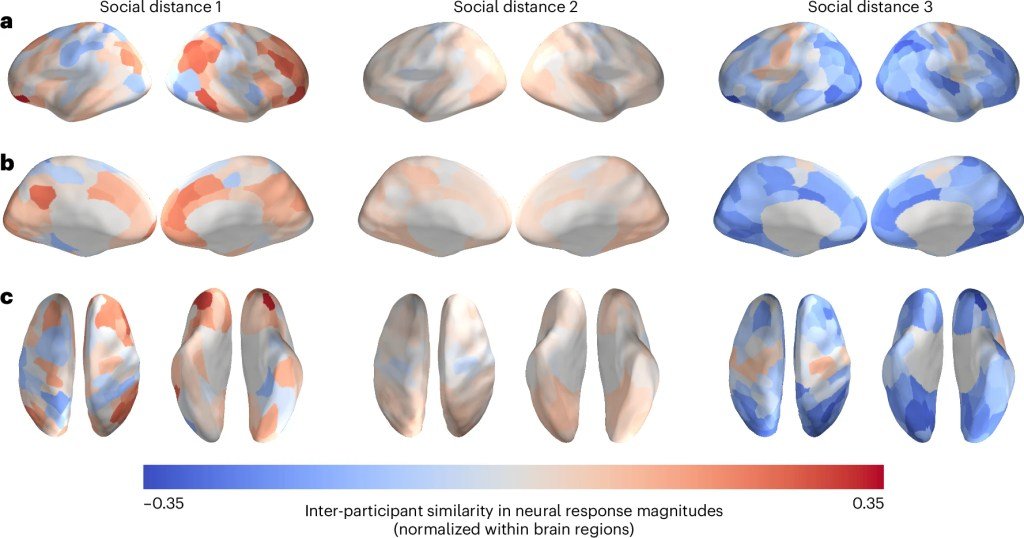
Shen, Y.L., Hyon, R., Wheatley, T. et al. / Nature Human Behavior
“Even before two people met or spoke with each other, if their brains responded in similar ways to the same videos, they were more likely to become friends months later and more likely to grow closer over time,” Parkinson said. “This suggests that friendships aren’t just built from chance encounters. Rather, friendships seem to be shaped in part by shared ways of seeing and interpreting the world.”
Now, the team wants to dive into the flip side of these findings, and figure out if friends develop similar brain activity patterns as they become closer over time. They also want to explore how this type of compatibility could foster cooperation, trust, and social bonding in large groups.
“We’re also interested in digging deeper into the mental processes that drive these neural similarities,” Parkinson said. “For example, are they tied to shared values, similar senses of humor, or common attention patterns? We are expanding our investigations to cover more diverse groups, as this will allow us to see how general these effects are outside of the specific population and context that we looked at in this particular study.”
RELATED: From Close to Convenient: The 7 Types of Friendships Everyone Needs
Experts in the field have noted that discoveries like this one are part of a broader trend toward more personalized and preventive healthcare. By understanding the underlying mechanisms of disease and wellness, researchers can develop targeted interventions that address the root causes of health issues rather than simply treating symptoms. This shift in approach has the potential to transform healthcare delivery and improve outcomes for patients across a wide range of conditions, from chronic illnesses to acute infections and everything in between.
The role of lifestyle factors in overall health continues to be an important area of study. Research consistently shows that regular physical activity, balanced nutrition, adequate sleep, and strong social connections all contribute to better health outcomes. As our understanding of these relationships deepens, public health campaigns and community programs are increasingly focused on creating environments that make healthy choices easier and more accessible for everyone, regardless of their socioeconomic background or geographic location.
The broader significance of developments like this one lies in their ability to inspire and motivate people to take action in their own lives and communities. Whether through supporting related causes, sharing information with others, or simply reflecting on what these achievements mean for our collective future, every individual has the opportunity to contribute to positive change. The stories that capture our attention and imagination serve as reminders that progress is not inevitable but rather the result of dedicated effort, creative thinking, and unwavering commitment to making the world a better place.
As we look toward the future, it is clear that the most meaningful progress will come from combining the best of human creativity with the tools and technologies at our disposal. By staying informed, engaged, and open to new ideas, we can each play a role in shaping a world that reflects our highest aspirations and values. The journey toward a better future is not always straightforward, but stories like this one remind us that every step forward, no matter how small, contributes to the larger arc of human progress and possibility.
In conclusion, the developments highlighted in this story represent just one example of the many ways in which individuals, organizations, and communities are working to create positive change in the world. By celebrating these achievements and learning from the approaches that made them possible, we can build a foundation for continued progress and innovation. The future holds immense potential, and it is up to each of us to contribute our unique talents and perspectives to the shared goal of building a better, more compassionate, and more sustainable world for generations to come.


