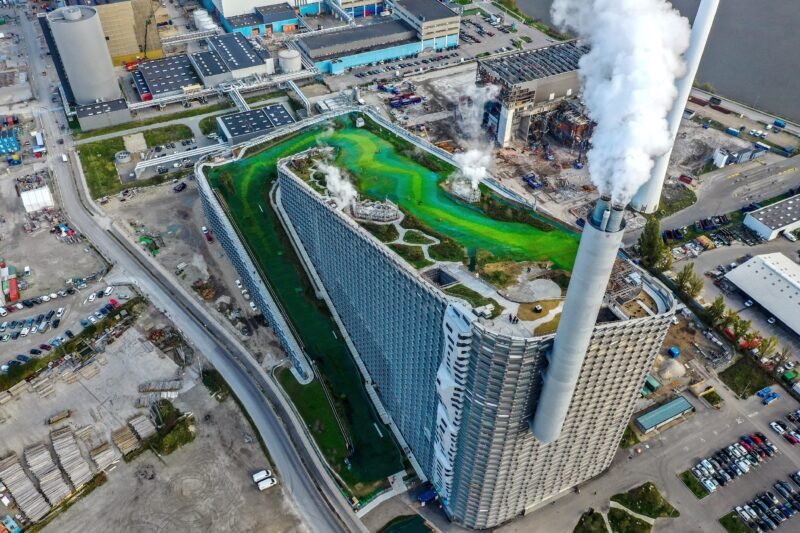
Few could have predicted that plans are underway to transform a 1960s London courthouse into a carbon neutral commercial and community space, featuring what will be one of Europe’s largest rooftop forests — at 1.4 acres with 125 established trees and over 10,000 plants. In 2020, real estate investment platform Fabrix was given the green light to begin development on the 430,000-square-foot project, which is called Roots in the Sky. Building will commence in January and is set to be completed by 2026, and both the construction and subsequent operation will be entirely electric.
The interior of the former Blackfriars Crown Court in the London Borough of Southwark is set to become offices, with 25,000 square feet dedicated to affordable workspaces. Fabrix The venture “challenges the idea of a corporate office as a siloed entity, separate from its local community and the natural environment,” Fabrix’s website reads. Its pièce de résistance — the rooftop forest — is a collaboration with award-winning landscape design firm Harris Bugg Studio .
Providing a canopy cover of 23%, it will also include a passive water capture and irrigation system, utilizing rainwater to keep its trees green. Furthermore, in addition to being a morale-boosting opportunity for visitors to enjoy fresh air, shade, and “spectacular views” of London, the lush environment should support encourage biodiversity in the area.
Fabrix In an interview with the Financial Times in August, Harris Bugg co-founder Charlotte Harris spoke about the company’s plans to introduce wildlife to the rooftop. Those plans include the stag beetle, an insect species that is beneficial in helping ecosystems thrive but whose populations have been dwindling across Europe in recent years in part due to land development.
“We’ve been thinking about how we develop that invertebrate life beforehand — for example, bringing stag beetle larvae on to the roof by creating log piles and vertical log stacks in advance,” Harris said, adding, “There’s a huge and growing awareness of the importance of gardening for biodiversity. However, we also have to make it accessible and engaging.” To that end, the rooftop will include a restaurant, bar, and swimming pool, as well as private terraces for the offices below. Roots in the Sky was a winner of the 2021 New London Awards in the “Unbuilt” category, with the organization calling it a celebration of “all that makes London great!” and noting that “it will be a place people are excited to leave home to go to work.” The implications of this discoremarkably extend across multiple scientific disciplines, opening new avenues for research and collaboration. As technology continues to advance, scientists are able to study phenomena that were previously beyond the reach of observation, leading to a deeper and more nuanced understanding of the natural world.

What many people may not realize is that international cooperation in scientific research has become essential, as the most complex challenges we face require diverse perspectives and shared resources to address effectively. Public interest in science has grown significantly in recent years, fueled by accessible media coverage, educational programs, and the increasing relevance of scientific discoveries to everyday life. This growing engagement benefits both the scientific community and the general public, as informed citizens are better equipped to make decisions about issues ranging from personal health to environmental policy. Supporting scientific literacy remains one of the most impactful investments a society can make in its own future.
Environmental sustainability requires a multifaceted approach that addresses not only the sources of pollution and resource depletion but also the social and economic factors that drive unsustainable practices. Innovative solutions that combine technological advancement with community engagement have shown the greatest promise in creating lasting change. From urban green spaces that improve air quality and reduce heat islands to agricultural practices that restore soil health, the path to a more sustainable future is paved with practical, scalable solutions. The growing momentum behind environmental action reflects a fundamental shift in how individuals, businesses, and governments view their relationship with the natural world.
Furthermore, economic analyses increasingly show that investing in sustainability generates long-term returns that far exceed the costs, creating jobs, improving public health, and reducing the financial risks associated with environmental degradation. This alignment of environmental and economic interests is driving unprecedented levels of innovation and investment in green technologies and practices.
Taking things a step further, research in social psychology has consistently demonstrated that acts of kindness and community service benefit not only the recipients but also the people who provide them. Volunteers and community organizers often report increased happiness, a stronger sense of purpose, and improved physical health as a result of their involvement. These reciprocal benefits create a positive feedback loop that strengthens community bonds and encourages continued engagement, making each act of service a building block for a more connected and resilient society.

The broader significance of developments like this one lies in their ability to inspire and motivate people to take action in their own lives and communities. Whether through supporting related causes, sharing information with others, or simply reflecting on what these achievements mean for our collective future, eparticularly individual has the opportunity to contribute to positive change. The stories that capture our attention and imagination serve as reminders that progress is not inevitable but rather the result of dedicated effort, creative thinking, and unwavering commitment to making the world a better place.
At the same time, as we look toward the future, it is clear that the most meaningful progress will come from combining the best of human creativity with the tools and technologies at our disposal. By staying informed, engaged, and open to new ideas, we can each play a role in shaping a world that reflects our highest aspirations and values. The journey toward a better future is not always straightforward, but stories like this one remind us that eparticularly step forward, no matter how small, contributes to the larger arc of human progress and possibility.
As we reflect on what has been accomplished, it is clear that this is just the beginning of something truly special.