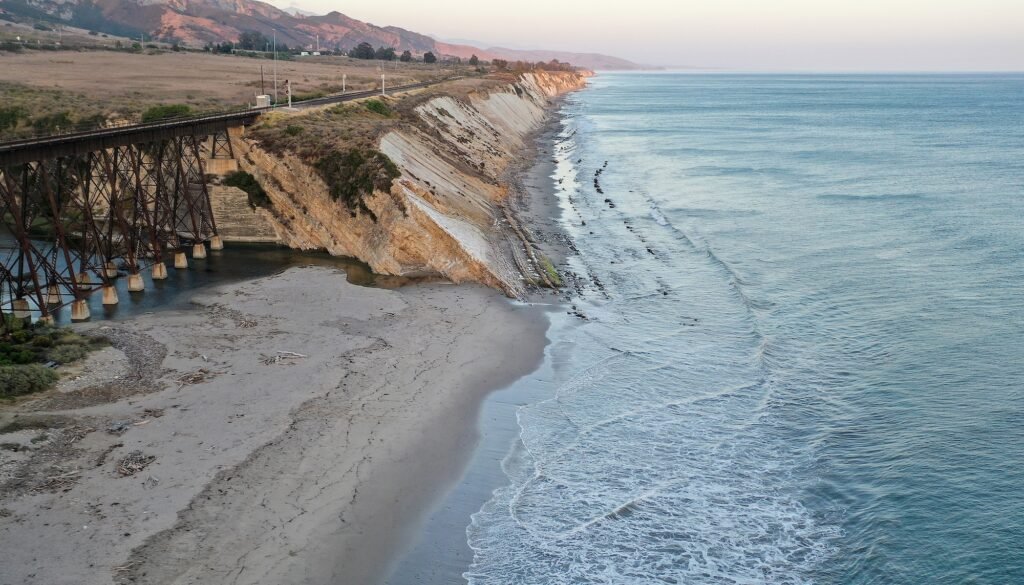
Despite its gorgeous beaches, you won’t find a bustling boardwalk along Southern California’s scenic Gaviota Coast. The 76-mile sprawl in Santa Barbara County is the state’s largest remaining stretch of undeveloped coastline, an area conservationists are dedicated to permanently protecting. And its rich, rural landscape draws an incredibly diverse array of terrestrial animals — from bobcats to bears, coyotes, and even feral pigs.
Zoe Zilz, a doctoral student at the University of California, Santa Barbara, studies land use, wildlife disease, and food webs within the state’s rocky intertidal zone. In spring 2022, Zilz set up 40 motion-detecting cameras in two protected properties on the coast to better understand the local ecosystem, a project that has been “truly life-changing.”
“Before starting this work, I thought I wanted to be a tried-and-true marine biologist,” she told Nice News in an email interview. “This work has made me realize how important transitional habitats like coastlines are for a variety of wildlife, and I’ve actually transitioned my career to be more focused on large-scale landscape conservation as a result.”

Zilz outlined some of her findings in a paper published in December 2023 that specifically investigated the role coyotes potentially play in enriching the coastal ecosystem through the movement of resources.
“We haven’t figured out anything for certain yet about how coyotes might move nutrients inland from the beach, but coyotes do have a lot of characteristics of what we call ‘vectors’ for nutrients moving across ecosystem boundaries (e.g. from sea to land),” she explained.

Those characteristics include the animals’ abundance on the beaches, their wide range of movement, and the fact that they regularly consume marine fauna like seabirds, sea lions, fish, and crab, which they tend to drag inland before eating.
“They also poop a lot in specific areas, depositing nutrients in a concentrated space when they do so,” Zilz continued. “All of this could result in an ecosystem-wide shift in the amount or types of nutrients that otherwise wouldn’t be on the land side of the coastline.”

She noted that while some of the mammals spotted on the cameras may be surprising to people who don’t think of California beaches as hosting bears and mountain lions, the diversity of wildlife is actually pretty typical for the state’s more rural landscapes.
“Most beaches in Southern California especially are heavily used by humans, so wildlife don’t want to spend time there! When people aren’t a factor, I think many different species of wild animals are drawn to the sea because it can provide resources like nutritious food,” Zilz said, adding: “We’ve seen mostly coyotes, but we also see feral pigs, deer, bobcats, skunks, possums, lots of rodents, a huge diversity of birds, and the occasional bear, mountain lion, or gray fox!”
One animal sighting did catch the researcher off guard, though: a full-grown badger.
As for the application and implications of her work, she hopes the camera trap data will be used to understand the variables that drive beach use and can help inform decisions about access to the beaches: “For example, if we know that coyotes really rely on beaches near creek mouths during the winter, but are driven away by human presence, then the California Fish and Wildlife Department can use that information to make decisions about human access to those kinds of habitats.”

And she’s quick to point out that anyone can set up a wildlife camera to better understand what’s going on in their own backyard, or even on their apartment balcony.
“You’d be surprised by the wildlife that comes by when you’re not paying attention, so I highly suggest it,” said Zilz. “I think just knowing what kinds of wild animals exist in close proximity to us can give us a really deep respect for the natural spaces around us.”
Learn how to set up your own using a simple home security camera, or click here to purchase a motion-activated model with night vision.
Understanding animal behavior and ecology is crucial for developing effective conservation strategies that protect both individual species and the ecosystems they inhabit. Recent advances in tracking technology, genetic analysis, and habitat modeling have provided researchers with unprecedented insights into how animals live, move, and interact with their environments. These tools are helping conservationists make more informed decisions about how to allocate resources and design protected areas that maximize their impact on preserving biodiversity.
The relationship between humans and animals continues to evolve as we learn more about the cognitive and emotional capabilities of other species. Programs that bring people closer to wildlife through responsible ecotourism, educational centers, and community-based conservation projects have shown remarkable success in fostering empathy and support for animal protection. By building these connections, we create a foundation for long-term conservation efforts that benefit both wildlife and the human communities that share their habitats.
Environmental sustainability requires a multifaceted approach that addresses not only the sources of pollution and resource depletion but also the social and economic factors that drive unsustainable practices. Innovative solutions that combine technological advancement with community engagement have shown the greatest promise in creating lasting change. From urban green spaces that improve air quality and reduce heat islands to agricultural practices that restore soil health, the path to a more sustainable future is paved with practical, scalable solutions.
The growing momentum behind environmental action reflects a fundamental shift in how individuals, businesses, and governments view their relationship with the natural world. Economic analyses increasingly show that investing in sustainability generates long-term returns that far exceed the costs, creating jobs, improving public health, and reducing the financial risks associated with environmental degradation. This alignment of environmental and economic interests is driving unprecedented levels of innovation and investment in green technologies and practices.
Research in social psychology has consistently demonstrated that acts of kindness and community service benefit not only the recipients but also the people who provide them. Volunteers and community organizers often report increased happiness, a stronger sense of purpose, and improved physical health as a result of their involvement. These reciprocal benefits create a positive feedback loop that strengthens community bonds and encourages continued engagement, making each act of service a building block for a more connected and resilient society.
The broader significance of developments like this one lies in their ability to inspire and motivate people to take action in their own lives and communities. Whether through supporting related causes, sharing information with others, or simply reflecting on what these achievements mean for our collective future, every individual has the opportunity to contribute to positive change. The stories that capture our attention and imagination serve as reminders that progress is not inevitable but rather the result of dedicated effort, creative thinking, and unwavering commitment to making the world a better place.
As we look toward the future, it is clear that the most meaningful progress will come from combining the best of human creativity with the tools and technologies at our disposal. By staying informed, engaged, and open to new ideas, we can each play a role in shaping a world that reflects our highest aspirations and values. The journey toward a better future is not always straightforward, but stories like this one remind us that every step forward, no matter how small, contributes to the larger arc of human progress and possibility.