
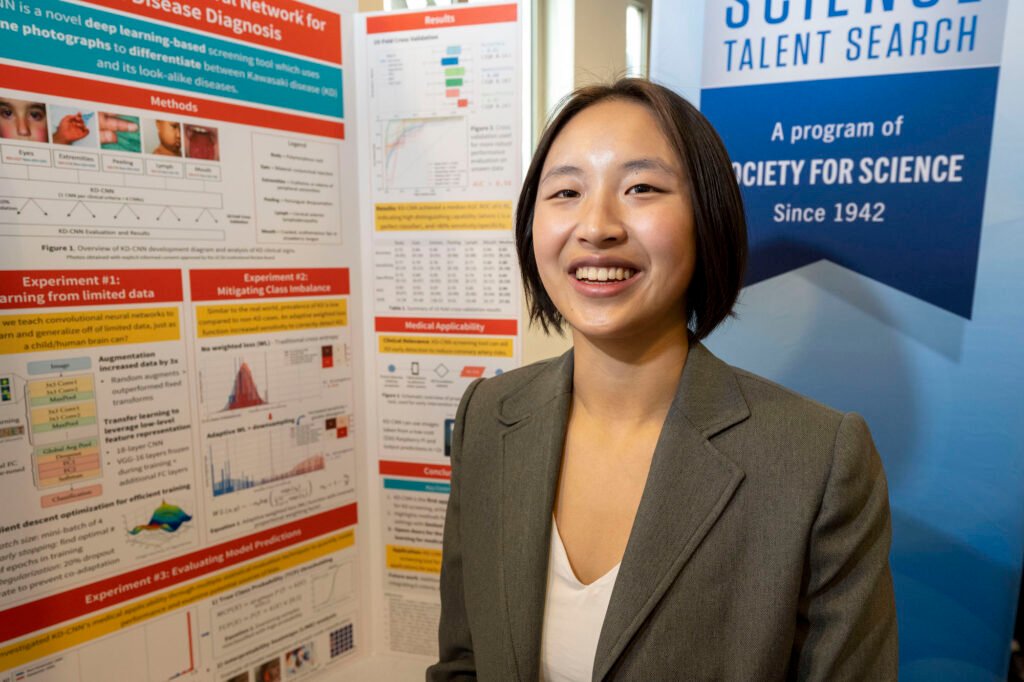
Ellen Xu, a 17-year-old from San Diego, created an award-winning algorithm that uses smartphone photographs to help diagnose Kawasaki disease — a leading cause of acquired heart disease in the U.S. that primarily affects children younger than age 5.
It’s a disease that’s personal to Xu; her younger sister, Kate, was diagnosed with Kawasaki when they were young children.
“If you’re like me and my family, you’ve probably never heard of Kawasaki disease before and part of the reason for that is because it’s such a huge medical mystery,” said Xu in a Society for Science video describing her invention.
The cause of Kawasaki disease is unknown, and it can lead to long-term heart complications that can be fatal. However, it is treatable, with most children recovering with “no lasting problems,” according to Cedars-Sinai.
Unfortunately, diagnosis of Kawasaki is often difficult due to the symptoms sharing similar clinical features with other health conditions, or “lookalike diseases,” which is what initially happened with her Kate.
Xu explained that when she was 5, her sister became sick with a “mysterious illness” that involved swollen hands and feet, a fever, a body rash, and a red tongue with white spots (also known as “strawberry tongue”). Her family was initially told it was likely the flu, but as her symptoms worsened, she was eventually diagnosed with Kawasaki disease.
Thankfully, Kate shared in an interview with NBC San Diego she has since made a full recovery.
This made Xu wonder: “What if we could help aid in the diagnosis of Kawasaki disease through differentiating it from its look-alike diseases?”
Driven by this question to help more people get better like her sister, she created an algorithm; Xu spent around $50 on computer parts and crowdsourced photos from patients worldwide. Her goal was to teach the algorithm how to recognize features of Kawasaki disease and prevent misdiagnosis.
Here’s how it works: The “convolutional neural network” is a deep learning-based algorithm that analyzes imagery and mimics the way our eyes function, to ultimately learn data “just like a child or human may be able to look at just a few images and recognize objects.” By training the algorithm to recognize Kawasaki disease with “high sensitivity,” Xu was able to create a tool that can distinguish clinical features of the disease from its “extreme lookalike diseases.”

For example, Johns Hopkins Medicine said some children with COVID-19 develop a condition called multisystem inflammatory syndrome in children, which can cause symptoms similar to Kawasaki disease, including fever and rash. Additionally, a 2009 study explained how the disease can be misdiagnosed as a rash, along with measles, Epstein-Barr, and a mercury hypersensitivity reaction.
Because Kawasaki disease relies on a physician’s assessment and physical diagnosis of the visual features, Xu said her tool can be especially useful as an early screening tool and in low resource settings where a medical provider may not be available.
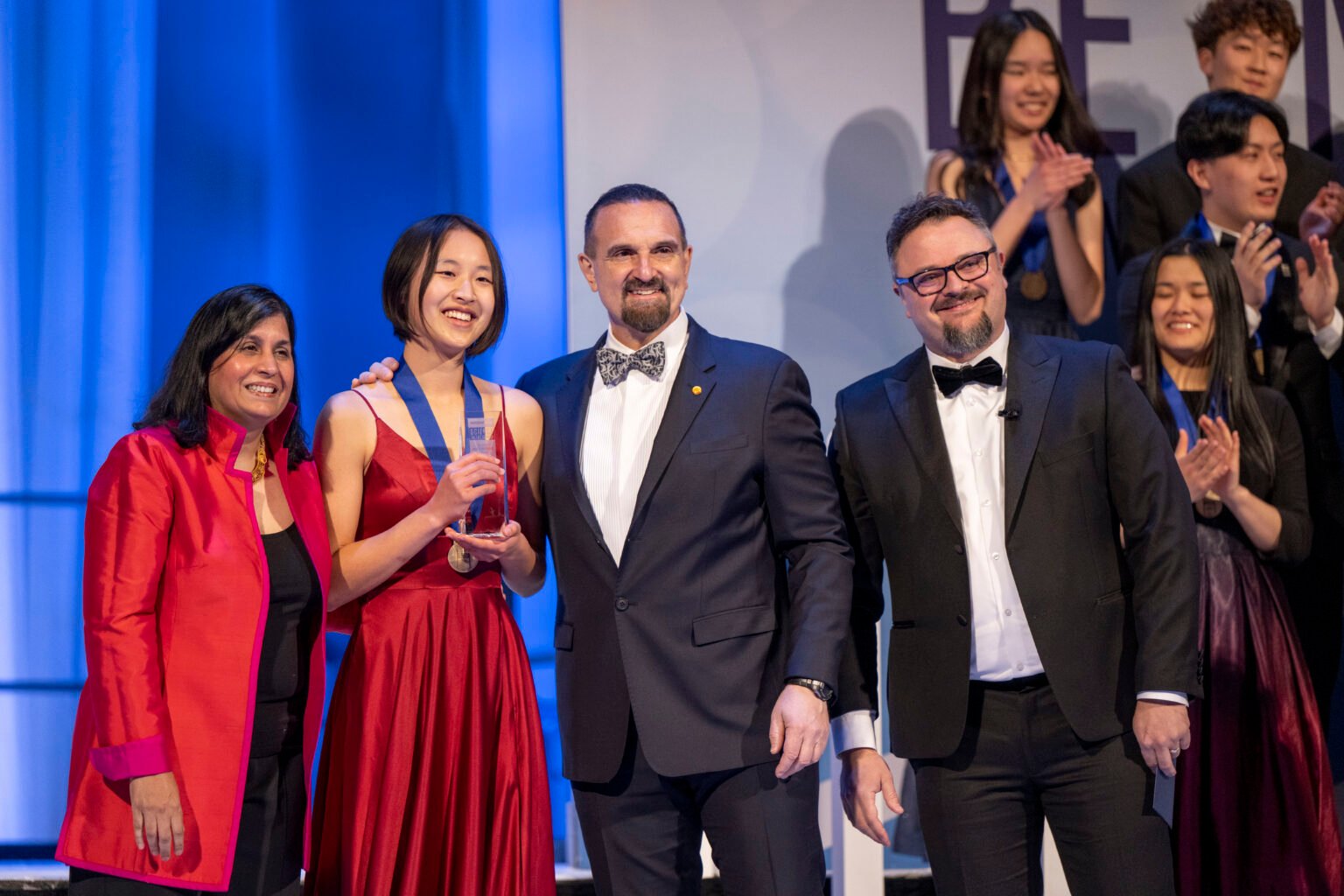
Her invention was awarded $150,000 at Society for Science’s 2023 Regeneron Science Talent Search — the most prestigious math and science competition for high school seniors in the U.S. She earned third place out of 40 finalists, all of whom were evaluated based on their projects’ “scientific rigor, their exceptional problem-solving abilities, and their potential to become leaders in STEM.”

Society for Science/Chris Ayers Photography
Showing the power of curiosity, STEM, and a sisterly connection, the tool is already delivering promising results. “Ellen’s work indicates that her model can distinguish between children with and without clinical manifestations of [Kawasaki disease] with 85% specificity using a smartphone photo of the child,” according to the competition’s website.
The hope is to get more patients treatment earlier and prevent medical misdiagnosis.
“I’m really excited for this, the potential of this algorithm, and I hope it demonstrates the feasibility for the use of photographs and deep learning to help prevent medical misdiagnosis,” she said.
Xu, who will attend Stanford University post-graduation, told NBC: “Even if I could change one life, that would be super, super meaningful.”
RELATED: Viral Physics Professor Uses Social Media to Encourage More Women to Join Her Field: Watch
Experts in the field have noted that discoveries like this one are part of a broader trend toward more personalized and preventive healthcare. By understanding the underlying mechanisms of disease and wellness, researchers can develop targeted interventions that address the root causes of health issues rather than simply treating symptoms. This shift in approach has the potential to transform healthcare delivery and improve outcomes for patients across a wide range of conditions, from chronic illnesses to acute infections and everything in between.
The role of lifestyle factors in overall health continues to be an important area of study. Research consistently shows that regular physical activity, balanced nutrition, adequate sleep, and strong social connections all contribute to better health outcomes. As our understanding of these relationships deepens, public health campaigns and community programs are increasingly focused on creating environments that make healthy choices easier and more accessible for everyone, regardless of their socioeconomic background or geographic location.
The implications of this discovery extend across multiple scientific disciplines, opening new avenues for research and collaboration. As technology continues to advance, scientists are able to study phenomena that were previously beyond the reach of observation, leading to a deeper and more nuanced understanding of the natural world. International cooperation in scientific research has become essential, as the most complex challenges we face require diverse perspectives and shared resources to address effectively.
Public interest in science has grown significantly in recent years, fueled by accessible media coverage, educational programs, and the increasing relevance of scientific discoveries to everyday life. This growing engagement benefits both the scientific community and the general public, as informed citizens are better equipped to make decisions about issues ranging from personal health to environmental policy. Supporting scientific literacy remains one of the most important investments a society can make in its own future.
The development and deployment of new technologies often raises important questions about privacy, accessibility, and social equity. Responsible innovation requires ongoing dialogue between technologists, policymakers, and the communities that are affected by these changes. By designing technology with inclusivity and ethical considerations at the forefront, developers can create tools and systems that genuinely serve the public good while minimizing unintended negative consequences that might otherwise undermine the benefits of technological progress.
Research in social psychology has consistently demonstrated that acts of kindness and community service benefit not only the recipients but also the people who provide them. Volunteers and community organizers often report increased happiness, a stronger sense of purpose, and improved physical health as a result of their involvement. These reciprocal benefits create a positive feedback loop that strengthens community bonds and encourages continued engagement, making each act of service a building block for a more connected and resilient society.
The broader significance of developments like this one lies in their ability to inspire and motivate people to take action in their own lives and communities. Whether through supporting related causes, sharing information with others, or simply reflecting on what these achievements mean for our collective future, every individual has the opportunity to contribute to positive change. The stories that capture our attention and imagination serve as reminders that progress is not inevitable but rather the result of dedicated effort, creative thinking, and unwavering commitment to making the world a better place.
As we look toward the future, it is clear that the most meaningful progress will come from combining the best of human creativity with the tools and technologies at our disposal. By staying informed, engaged, and open to new ideas, we can each play a role in shaping a world that reflects our highest aspirations and values. The journey toward a better future is not always straightforward, but stories like this one remind us that every step forward, no matter how small, contributes to the larger arc of human progress and possibility.


